Establishment of the First Archaeology Museum
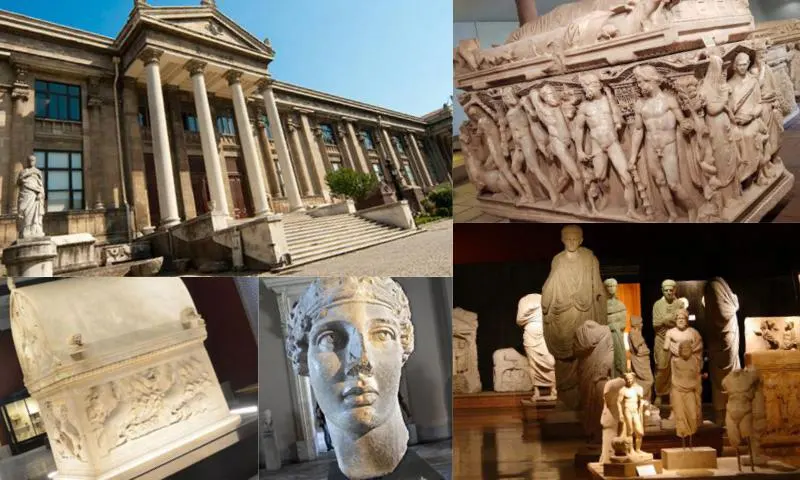
The nucleus of the first Turkish museum was laid in 1846 when the artifacts collected in the Hagia Irene church, located in the first courtyard of Topkapi Palace since the reign of Fatih, were joined by artifacts collected by Ahmet Fethi Pasha, the Master of the Ordnance of Tophane. As this museum, consisting of military and archaeological artifacts, became full, the archaeological artifacts were moved to the Çinili Köşk in 1876, and the first Archaeology Museum was established under the name Müze-i Hümayun. The German Dethier was appointed as its director. During these times, due to the interest in archaeology in Europe, many excavations were carried out in Anatolia, and many of the artifacts unearthed filled the museums of Europe. For example, Schliemann found and smuggled out the treasure of Priam in Troy, Karl took the Deesis mosaic from the council of consuls hall in Hagia Sophia, and Humann dismantled the Temple of Zeus in Pergamon and took it to Berlin. Artifacts from Ephesus, Miletus, Priene, and Halicarnassus in Bodrum were being taken abroad one by one. In 1881, Osman Hamdi Bey, who succeeded Dethier upon his death, issued the Antiquities Regulation to prevent this looting, ensuring that at least some of the artifacts were collected in the museum, preventing their export. Furthermore, when he brought the Alexander Sarcophagus, the Weeping Women Sarcophagus, and the Tabnit Sarcophagus, along with lead sarcophagi found in Sidon in 1887, the artifacts no longer fit in the museum. Thus, Osman Hamdi Bey had the current 2-story building, 190 meters long, constructed between 1892-1902, although the building was completed in 1908. The building is the work of architect Valaury and was inspired by the Alexander Sarcophagus and the Weeping Women Sarcophagus.
Archaeology Museum Artifacts
The building has 36 large halls, 20 on the lower floor and 16 on the upper floor. However, today, the upper floor houses ceramic artifacts from prehistoric times to the Byzantine era, along with artifacts from Troy, Yortan, Hacılar, Ionia, Aeolia, and Caria, as well as medal and treasury and numismatic sections, which are currently closed. The treasury section contains rich finds such as gold earrings and bracelets found in Troy, a gold wreath found in Pergamon, and gold artifacts found in Ephesus and Sardis. In addition, there are nearly 500,000 coins and medals. The Istanbul Archaeology Museum, one of the richest museums in the world, houses nearly 60,000 archaeological artifacts alongside 75,000 tablets. Let's explore this beautiful museum, composed of archaeology, ceramics, and ancient Near East artifacts, starting with the archaeology museum. A triangular pedimented entrance supported by four columns is reached by white marble stairs. From here, one enters a hall. There are many sections to the right and left of the hall. Let us now enter the first section on the left to see the world-famous masterpieces.
Alexander Sarcophagus Hall
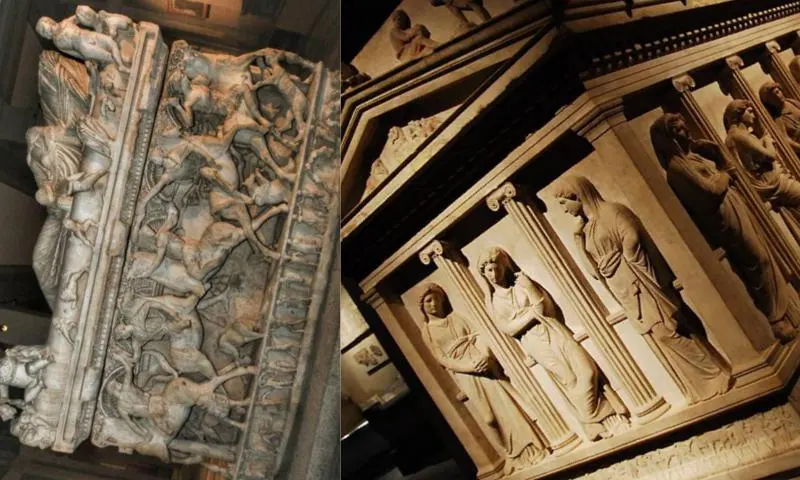
The sarcophagi seen in this section were found in the royal necropolis of Sidon. One day, in the village of Halaliye, east of Sidon in Syria, a man named Mehmed Şerif noticed a well in his field and reported it to the governor of Sidon. The Governor of Syria investigated on-site and reported the situation to Istanbul with a report. Thereupon, the museum director Osman Hamdi Bey set off for Sidon, which was then part of the Ottoman Empire. In the excavation, which lasted from April 30 to June 20, 1877, he determined that the sarcophagi were in two separate caves. It was observed that the first of the well-shaped caves had been looted, while the second had not been touched. The sarcophagi were removed from the caves by constructing an underground passage during the excavation. It was understood that the cave where the Tabnit sarcophagus was found was built in the 5th century BC, while the others were excavated later to place the sarcophagi. It was determined that the Alexander Sarcophagus and three sarcophagi similar to it were placed here at the end of the 4th century BC. The sarcophagi were also used by others after their original owners. For example, the inscription on the Tabnit sarcophagus mentions the name of an Egyptian general. The sarcophagus known as the Alexander Sarcophagus does not belong to Alexander but acquired its name because it depicts his battles. These sarcophagi unearthed in Sidon were transported to Istanbul by ship and displayed as we see them today. In front, after three sarcophagi dating from the 4th century BC, the Alexander Sarcophagus, one of the world's masterpieces, is seen at the back. Made of white marble, consisting of a tub and a lid, the sarcophagus is 2.12 m high, 3.18 m long, and 1.67 m wide. One of the large and small facades depicts the war between the Persians and the Greeks, while the other sides depict scenes of lion and deer hunting, and the pediment of the lid also features war and hunting scenes.
Depictions of the Alexander Sarcophagus Artifact
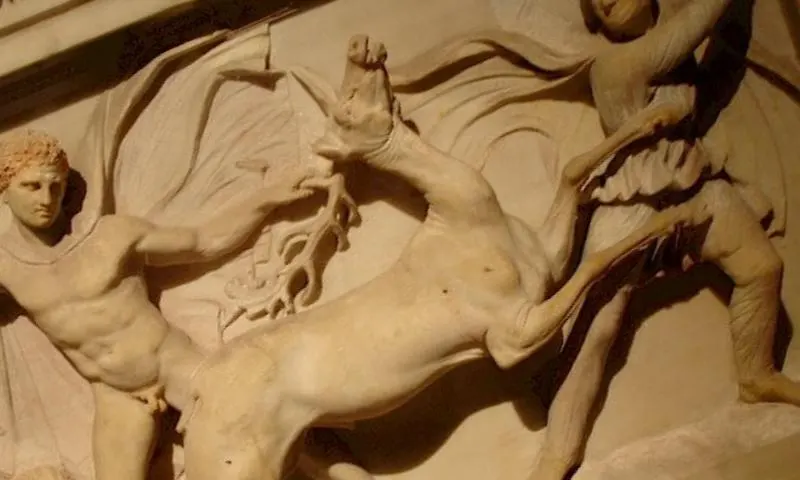
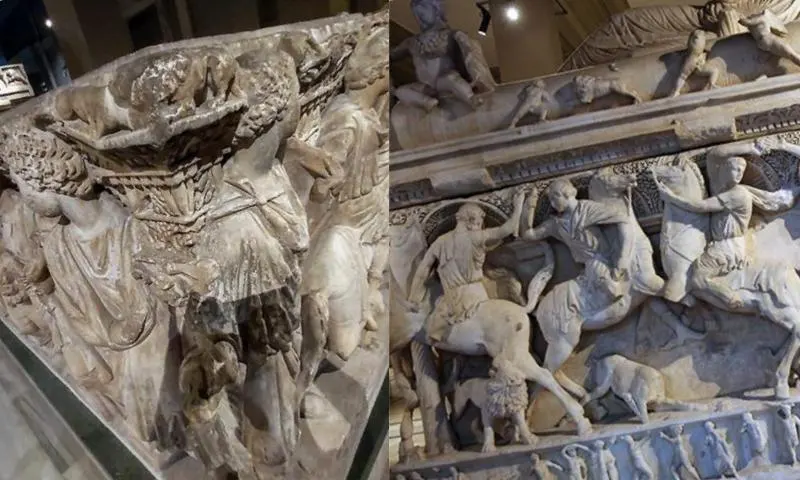
On the front face depicting the battle between Alexander and the Persians, Alexander is on the left, wearing a lion's skin, the symbol of Heracles, on his head, and there are horns near the ears, the mark of the Egyptian god Amun. Alexander's horse is rearing, with an arrow stuck in its chest, and is trampling over the body of a Persian. Alexander is chasing a Persian with his raised spear, and the Persian's horse is stumbling, trying to dismount. On the right end, a Macedonian cavalryman is killing a Persian cavalryman without paying attention to an arrow lodged in his left leg, while the Persian falls lifeless into the arms of another comrade. Between these two groups, two infantrymen are fighting, a Persian archer aiming at Alexander, a Macedonian cavalryman drawing his sword against a Persian infantryman, and a Persian archer shooting an arrow at the Macedonian cavalryman are depicted. On the other long face, a lion and deer hunt is depicted. In the center, a large lion, wounded in several places and covered in blood, attacks a Persian cavalryman's horse, piercing its shoulder with its claws and tearing its chest with its teeth. Cavalrymen are rushing to the aid of the rider from both sides, and the Persian behind the lion is about to strike the lion with his axe. The rider to the left of the lion is Alexander, wearing a band symbolizing royalty on his head. On the left end, a Persian is shooting an arrow at a lion. In front of him, a naked person is running. On the far right, a deer hunt is depicted, which is separate from the other scene. On the other face, while the artist intricately depicted animal and human figures in the battle scene, the figures in the hunting scene are more sparsely rendered, thus creating a realistic depiction on both sides. One of the narrow faces also depicts a battle scene. In the center, a cavalryman is attacking a fallen naked figure with a spear. On the right and left ends, kited Persian and Greek warriors are depicted. The pediment also features a war scene in this manner. The other narrow face depicts a leopard hunt.