
The History and Recent Past of Hagia Sophia Mosque
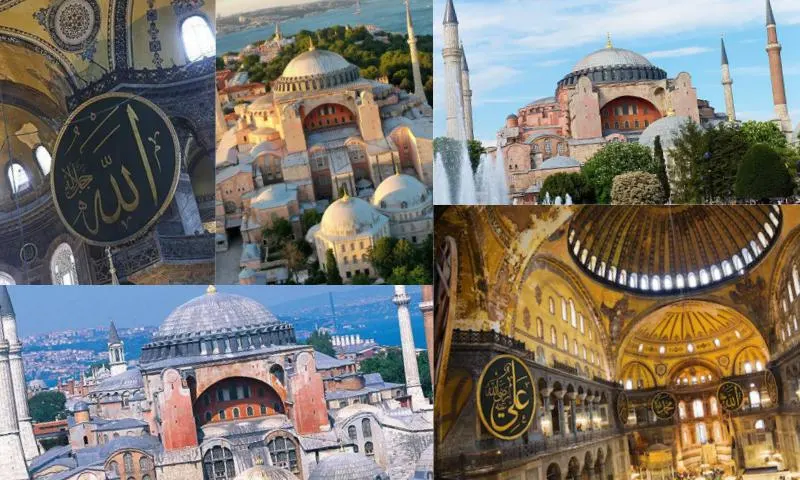
The Roman Empire, which spread across three continents, built monumental structures befitting their empires in every country. In Istanbul, a city of Rome, they also built Hagia Sophia during this period. Hagia Sophia is a unique masterpiece of world architectural history. The construction of the structure, which holds a distinct place in art literature with its legends, architectural features, and the mosaics adorning its interior, began in 326 during the reign of Constantine I (Constantine the Great). However, some historians state that the first structure was built by Constans, the son of Constantine the Great, and opened for worship by Constantius II.
Construction Phases of Hagia Sophia
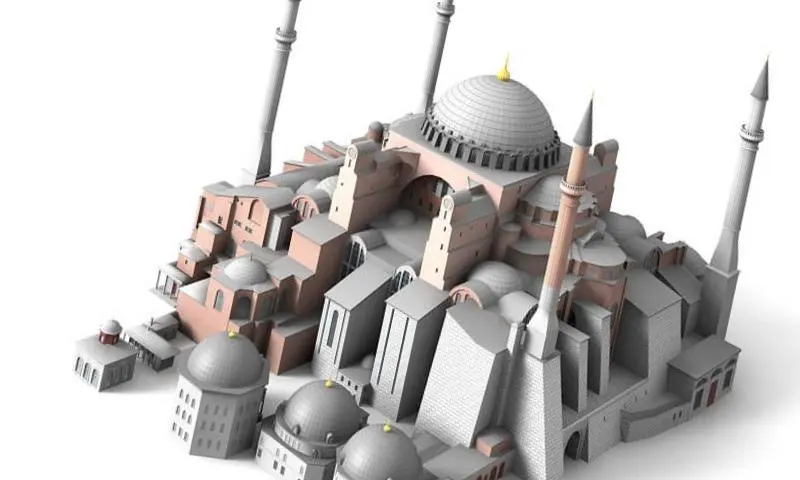
The first Hagia Sophia was built as a basilica with stone walls and a wooden roof, and it was named “Megali Ecclesia,” meaning “Great Church,” as it was the largest church in the city. Later, the structure, known as “Thea Sophia,” began to be called “Hagia Sophia,” meaning “Holy Wisdom,” from the 5th century onwards. The first Hagia Sophia was not long-lived. It was burned and destroyed during an uprising (June 20, 404) that occurred when the Patriarch of Constantinople, John Chrysostom, was exiled during the reign of Emperor Arcadius. Hagia Sophia was rebuilt for the second time during the reign of Theodosius II and opened for public worship on October 10, 415. Although not much is known about the plan of the second Hagia Sophia, it is believed to have been a five-nave basilica designed by the architect Roffinos. In 1936, excavations conducted by German archaeologists in the garden of Hagia Sophia unearthed some foundations and architectural elements, and their evaluation revealed that the structure had an entrance with columns, accessible by a five-step staircase. Research on this structure, which was 60 meters wide, was later halted to avoid damaging the foundations of the current Hagia Sophia. The column capitals, columns, and other architectural pieces unearthed during the excavations are exhibited in the garden of the structure today. The second Hagia Sophia, built by Theodosius II, burned down along with other buildings as a result of the bloody Nika revolt, which broke out due to rivalry between the Blue and Green factions on the night of January 13, 532. Emperor Justinian, after suppressing the revolt with the help of his wife Theodora, ordered Hagia Sophia to be rebuilt from scratch.
How Hagia Sophia Got Its Name
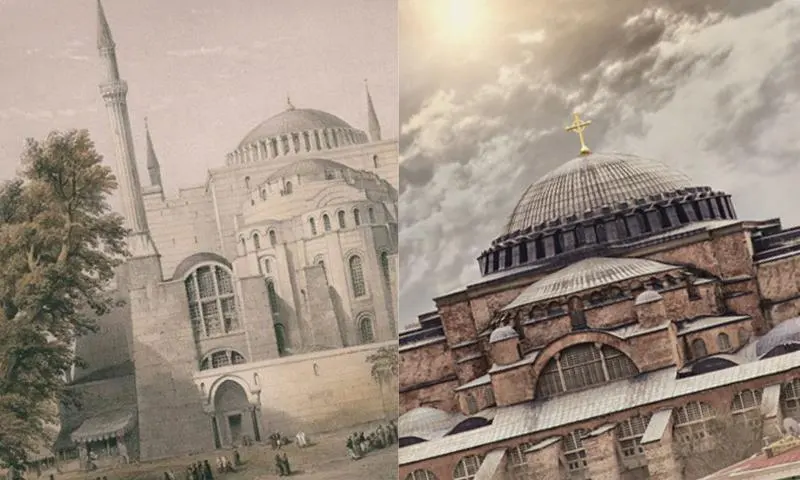
It is said that Emperor Justinian saw a radiant old man in a dream at the site of Hagia Sophia one night and immediately went to him. The saint held a silver tablet with the image of Hagia Sophia drawn on it. Seeing this, the emperor was greatly excited and said, “My Lord, if I had this tablet, I would build my temple according to it.” At that moment, the saint turned to the emperor, smiled, and offered him the tablet. “Take it and build your temple according to this image,” he said. Thereupon, the emperor asked, “What name should I give the temple?” To which he replied, “Hagia Sophia.” The emperor immediately summoned his architect in the morning and told him about the dream he had. Coincidentally, the architect had also seen the same dream and had drawn the image of the temple given to him by the saint that night after waking up. Whether it was due to the influence of this dream or his passion for building a great temple, Emperor Justinian lost no time in putting his plans into action and commissioned Anthemius of Tralles and Isidore of Miletus to build a magnificent temple. Justinian wanted the structure to be a temple unseen and never to be seen since Adam. It would be the largest and most beautiful temple in the world, surpassing even the temple of Solomon in Jerusalem. To realize this dream, he was prepared to spend the entire revenue of the empire. For example, the annual revenue of Egypt was allocated solely for the construction of the chambers called Ambon and Suela. The commissioned architects first embarked on extensive expropriation due to the small size of the previous site and its surrounding houses, spending a large sum of money in this regard.
The Location Where Hagia Sophia Was Built
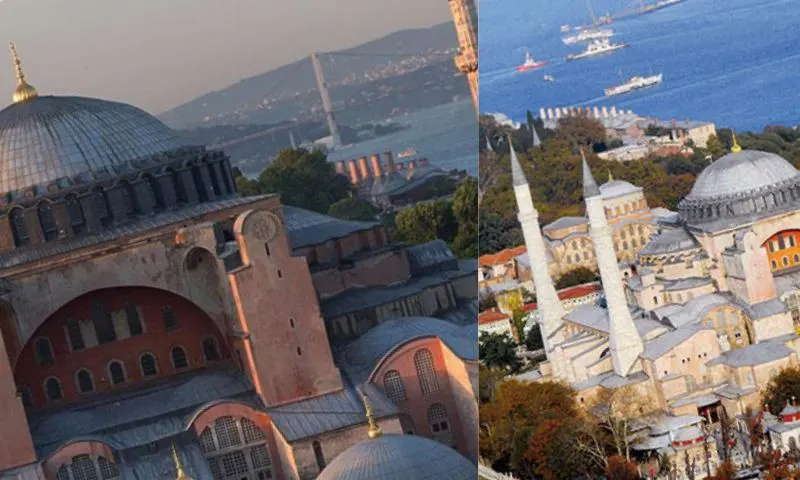
To the south of the area where Hagia Sophia would be built was a large square called the Augusteum, adorned with a bronze equestrian statue of Justinian, used for processions and ceremonies. To the north lay the emperor's churches, famous monasteries, and the mansions of state dignitaries, located within the current Topkapi Palace walls. To the east was the emperor's palace. After the expropriations, Anthemius and Isidore began preparations in one of the most beautiful parts of Istanbul to create a great structure that would withstand fires and earthquakes and endure for centuries. For this purpose, they sought to transport materials from temples in various parts of the empire. They brought eight red porphyry columns from the Temple of Artemis in Ephesus to Istanbul and used them in the construction of the structure, and they also utilized materials from the ruins of Athens, Rome, Baalbek, and Delphi through the governors. In addition, the world's most famous marble quarries were utilized for Hagia Sophia during this period. In addition to white marbles, light green marbles from the island of Euboea, yellow marbles from Algeria, pink veined marbles from Sigra, and white and red marbles from Southwestern Anatolia were brought and generously used in Hagia Sophia.
Construction of Hagia Sophia
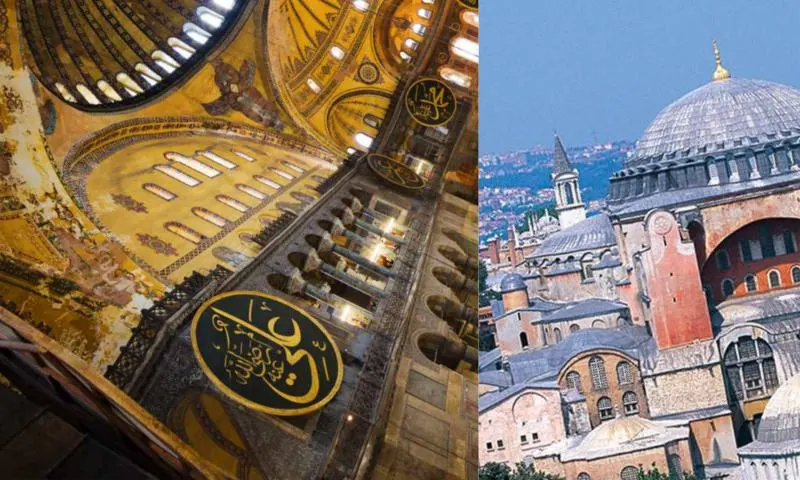
During the construction, which began in 532, a thousand artisans and ten thousand laborers worked daily, and the emperor himself personally supervised these operations. While the daily wages of the workers were paid regularly, rewards were given to the groups that accomplished more work, leveraging the competition among the laborers, ensuring the swift completion of the construction. During the construction, large cisterns were built beneath the foundation of the structure, and the pebbles placed inside them were intended to provide resistance against earthquakes. Bricks were used in the main walls, domes, and arches of the church, while the piers and tie beams were made of cut stone, and architectural elements like column capitals were made of faced colored marbles. All these valuable materials, as mentioned earlier, were brought from ancient ruins and the marble quarries on Marmara Island. Hagia Sophia, whose dome was described as a miracle of its time and caused great reverberations worldwide, was completed after 5 years, 11 months, and 10 days of construction, and its opening ceremony was held by Emperor Justinian on December 27, 537. Justinian, riding in a chariot pulled by fourteen horses, was welcomed by church dignitaries in the atrium of the church. The delegation, proceeding together towards the emperor's gate, was then met by Patriarch Menas, and they proceeded together into the Narthex. As they moved into the main naos, the emperor and the patriarch held hands as per protocol. Moving towards the apse, Justinian, seeing his dreams realized, moved towards the apse with great excitement and pride, raising his hands and exclaiming, “Praise be to God, who deemed me worthy to complete such a work. O Solomon, I have surpassed you.” However, this proud emperor witnessed the collapse of the eastern part of the dome during earthquakes in 553, 557, and 559, even during his lifetime, and saw the collapse of the place where the bread and wine cabinet stood and the holy liturgy table.